
Grief is existing in a world made other by having no path back to knowing ourselves.
Menschen
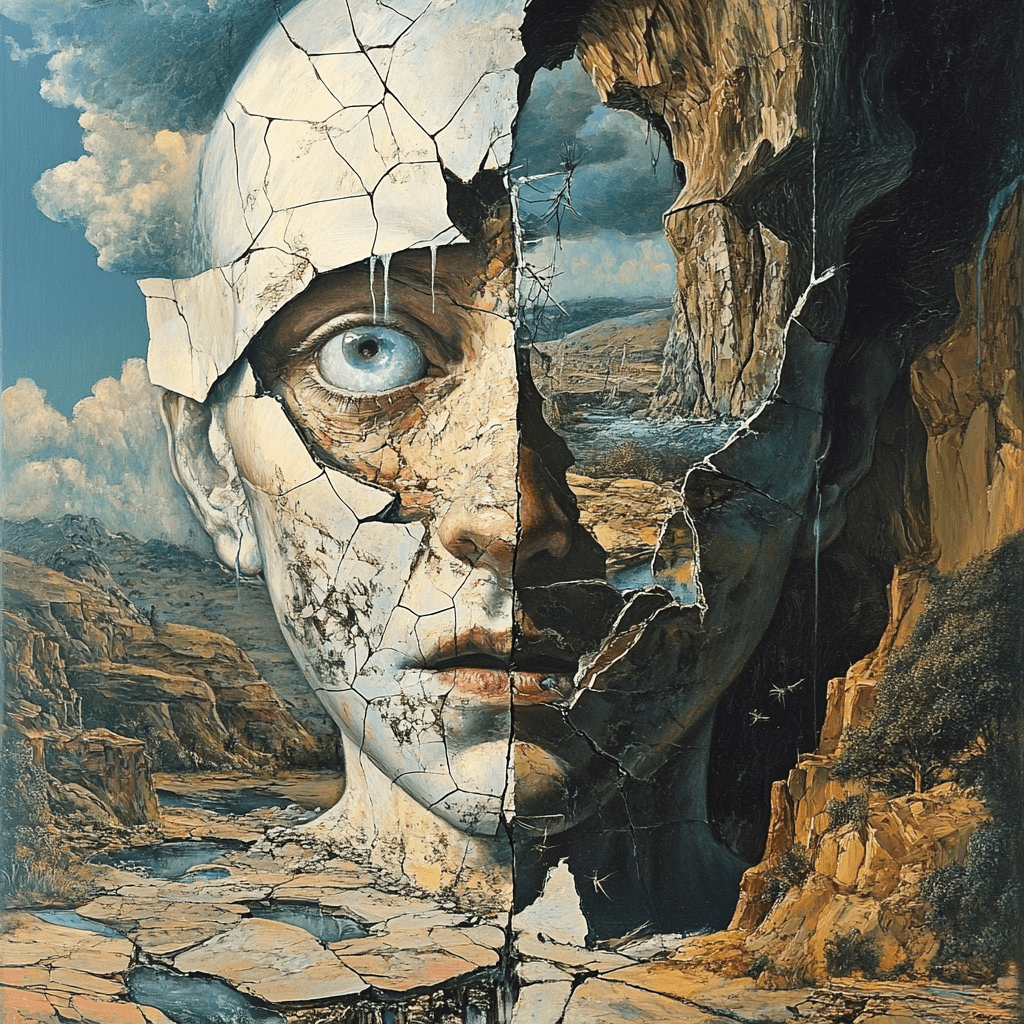
The abyss yawns. Not the abyss of nothingness, but the abyss of the self, shattered, splintered, unrecognizable. Grief, I have found, is not merely the absence of something loved, but the absence of oneself, the self one thought they knew. It is to stumble upon a forgotten photograph, a face that stares back, familiar yet alien, a ghost of the person you once were.
Before grief, the world existed in a comforting, predictable order. There were routines, expectations, a sense of continuity, a narrative of self that unfolded with a reassuring predictability. Now, that narrative lies in ruins, scattered across the landscape of loss like debris after a violent storm. The familiar landmarks – the shared laughter, the comforting touch, the anticipated future – have vanished, leaving behind a disorienting void.
This void, however, is not merely an absence. It is an active force, a corrosive agent that erodes the very foundations of our being. It compels us to confront the terrifying truth of our own contingency, the precariousness of our existence. We are thrown back upon ourselves, stripped bare of the comforting illusions of control and permanence, left to grapple with the terrifying realization that our existence is ultimately meaningless, absurd.
And yet, within this abyss, a strange kind of freedom emerges. Freed from the constraints of the familiar, the self is thrown into a state of radical uncertainty. The old maps are useless, the old compasses point in no discernible direction. We are adrift in a sea of uncertainty, forced to navigate by the stars of intuition, the whispers of the unconscious, the fleeting glimpses of a new, unknown self.
This is the true reckoning of grief: not merely the mourning of a lost object, but the mourning of the self, the self that was inextricably bound to the lost object. It is a descent into the depths of our own being, a confrontation with the abyss of our own unknowing. We are forced to confront the terrifying truth that we are not fixed entities, but fluid, ever-changing beings, constantly in flux, forever becoming.
The world, once a familiar landscape, now appears alien, distorted, refracted through the prism of loss. Colors seem less vibrant, sounds less meaningful. The world, in essence, has become “other,” reflecting the fractured state of the self.
And so, we are left to wander, lost in the labyrinth of our own being, searching for a path back to ourselves, a way to reclaim the shattered fragments of our identity and forge a new, authentic self from the wreckage of the past. This is the arduous and uncertain task that confronts us in the aftermath of loss, a journey into the unknown, a leap of faith into the abyss.
The path forward is not clear. There are no guarantees, no promises of redemption. Only the ever-present possibility of despair, the constant threat of being swallowed by the abyss. Yet, within this despair, there is also the possibility of profound transformation, the chance to emerge from the crucible of grief, not as the same person we were before, but as something new, something more authentic, something more profoundly human.
This is the predicament of grief: to exist in a world made other by the absence of the self, to navigate the abyss of unknowing, and to forge a new path forward, a path that may lead to despair, but may also lead to a deeper, more authentic understanding of ourselves and our place within the cosmos.

 The Grieviary
Leave a comment