There is a nothingness to the words we would use when we are living their concept, it is not until after we have moved through the fire, scathed, that we are free to use what words we will.
Gérontas

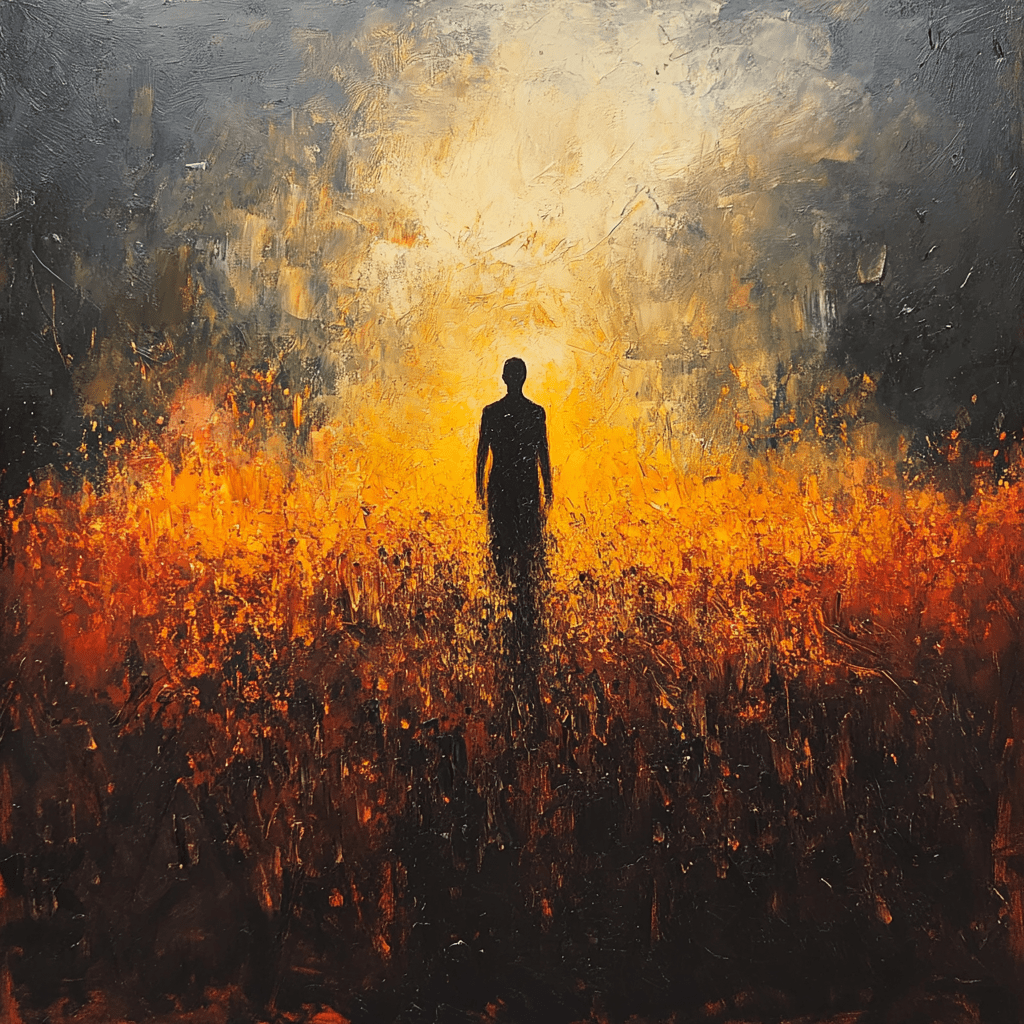
There are moments in life when language abandons us. Or rather, when we abandon it. When we live inside the fire—grief-stricken, fevered with love, wretched with loss—words dissolve. We do not describe pain while we are drowning in it; we do not narrate joy when it swallows us whole. There is, in these moments, a silence that is not chosen but imposed, a silence that arises because the self is too near to what it suffers or celebrates. This is not the silence of peace, but the silence of proximity.
A truth too often overlooked: words are creatures born out of the aftermath of experience. They lag behind experience like the echo of a scream in a canyon, audible only when the voice has already broken against the rock. When we are in the thick of it, whatever ‘it’ may be—deathbeds, birth pangs, betrayals, revelations—language is a blunted instrument, a thing insufficient and pale. We do not speak fluently of pain while we are in pain. Instead, we stammer. We curse. We make animal sounds, half-formed, guttural. We grip hands, we press foreheads together, we sob. It is only afterward, scathed and changed, that we reach for words, crafting them to resemble what we once could not articulate.
Consider the mourner. The first days after loss are wordless. People approach, speak their condolences, offer the dull script of sympathy, but the grieving one only nods. A mute understanding passes between them: there are no words. Time moves, though unkindly, and the mourner changes, is changed. Then, months or years later, they tell the story. They sit at a table, with a friend or a stranger, and they find words for what was once beyond them. “This is how it was,” they say. And though they do not say everything—because everything cannot be said—they say enough.
The same holds for joy. The child in the throes of delight does not narrate his happiness. He shrieks, he runs in circles, he claps his hands. The lovers in the first collapse of passion do not exchange eloquent soliloquies on their condition. They laugh, they sigh, they move toward one another as if words were an obstacle to what must be done. Only later, when joy has passed or settled into something quieter, do we speak of it. “That was the happiest I have ever been,” someone says, and another, if they are honest, replies, “Tell me how.”
If language is an artifact of distance, it is also a weapon against forgetting. Words reconstruct what time erodes. We are narrative creatures, and we stitch meaning into the fabric of what once was. A soldier does not tell war stories while the battle still rages. He tells them years later, in dimly lit bars or at family gatherings, his voice measured, his eyes flickering. And even then, what he says is only a fraction of what he knows. There are parts he cannot tell, even after time has done its work. There are some silences that words cannot breach.
Yet, despite all this, we return to language. We trust it to bear the weight of what we have endured, even knowing it will fail us. We write, we speak, we shape sentences like bridges stretched between past and present. And in doing so, we find that words, though inadequate, are necessary. They do not replace experience, nor do they fully capture it, but they allow us to share something of what was once unspeakable.
I remember a night some years ago when a friend, shattered by loss, sat across from me at a kitchen table. He tried to speak and failed. Tried again. The words came haltingly, but they came. I said little. There was nothing to say. But as the hours passed, his words grew stronger, more certain. He spoke himself into something beyond his suffering. And though his pain was not lessened, it was, perhaps, given shape. In that shaping, something shifted.
This, I believe, is the true alchemy of experience: to transform the raw pain of existence into something meaningful, to translate the ineffable into the articulate, to use the very language that once felt so inadequate to bear witness to the profound truths that lie at the heart of the human condition.
We live beyond language, and yet we need it to make sense of having lived. We emerge from fire, scorched and changed, and we gather the words that were once beyond us. And if we are lucky, if we are careful, we use them well.

 The Grieviary
Leave a comment